Foundations
Software-Defined Manufacturing
The ideas guiding the next industrial revolution.

Foundational and the Factory as a System
Beyond point automation: The next industrial leap isn’t another robot arm or vision system bolted onto a legacy production line. Foundational is building factories from the ground up to be run by software, treating the entire production system as the unit of automation.
The factory starts in software: Before building the physical system, Foundational has built the factory in software using emulators. This software-first architecture creates a foundation for deploying, testing, and ultimately improving manufacturing capabilities before they reach the factory floor.
A compounding factory model: The larger wager is that AI-native factories can improve with each deployment, becoming cheaper and faster to build over time. Instead of automation economics that depend on rigid equipment and constant utilization, Foundational is pursuing a model where software and intelligence compound across factories.
Source: “Forget robots on assembly lines. Foundational Industries wants AI to run the entire factory”

The Factory Is the Product
Capacity is capability: Military advantage depends on more than fielding sophisticated weapons. It requires the ability to replenish, adapt, and manufacture at scale, making the means of production a strategic asset in their own right.
From products to production capacity: The authors propose a Capacity-as-a-Service model that would reward manufacturers for maintaining flexible production capability over time, rather than paying only for one-time runs of hardware. The result is an industrial base designed to grow, adapt, and surge as requirements change.
Factories that compound: Treating capacity as the product changes the economics of manufacturing itself. Instead of optimizing factories around short production runs, manufacturers can invest in scalable processes, advanced tooling, and automation that continuously lower costs, increase throughput, and make production more adaptable over time.
Source: “The Factory Is the Product”

Prompt-to-Print and the Future of Manufacturing
Natural language becomes the interface: As generative AI matures, manufacturing begins to shift from traditional CAD workflows toward prompt-driven design, where engineers describe intent in natural language and AI translates it into manufacturable geometry.
From design tools to manufacturing agents: Rather than simply accelerating existing workflows, AI has the potential to become an active participant in product development, iterating on designs, incorporating manufacturing constraints, and compressing the path from concept to production.
Manufacturing at the speed of thought: The long-term implication extends beyond faster prototyping. As AI-native design tools converge with digital manufacturing, the path from intent to production becomes dramatically shorter, enabling products to move from prompt to physical reality with unprecedented speed and flexibility.
Rethinking the Geography of Manufacturing
The factory map is changing: McKinsey argues that global manufacturing footprints are being reshaped by geopolitical risk, supply-chain fragility, and the accelerating pace of technological change.
Resilience over optimization: The era of purely cost-optimized global production is giving way to distributed manufacturing strategies that prioritize resilience, regionalization, and technological capability.
Technology as the new anchor: As robotics and advanced automation mature, production location will increasingly be determined by infrastructure, talent, and technology ecosystems rather than just labor cost.
Source: “Decoding disruption to reshape manufacturing footprints”

Physical AI and the Next Frontier of Robotics
AI leaves the screen: Deloitte’s Tech Trends 2026 report highlights the emergence of “physical AI”, which describes systems that move beyond digital outputs to perceive, reason, and act within the physical world through robots and embodied machines.
From automation to autonomy: Advances in sensors, foundation models, and edge compute are enabling robots to adapt to dynamic environments rather than executing rigid, pre-programmed tasks.
Manufacturing as the proving ground: Factories and logistics networks are likely to be the first large-scale environments where physical AI is deployed, turning robots from single-purpose tools into learning systems that continuously improve through interaction with the real world.
Source: “AI goes physical: Navigating the convergence of AI and robotics”
Simulation as the Training Ground for Robots
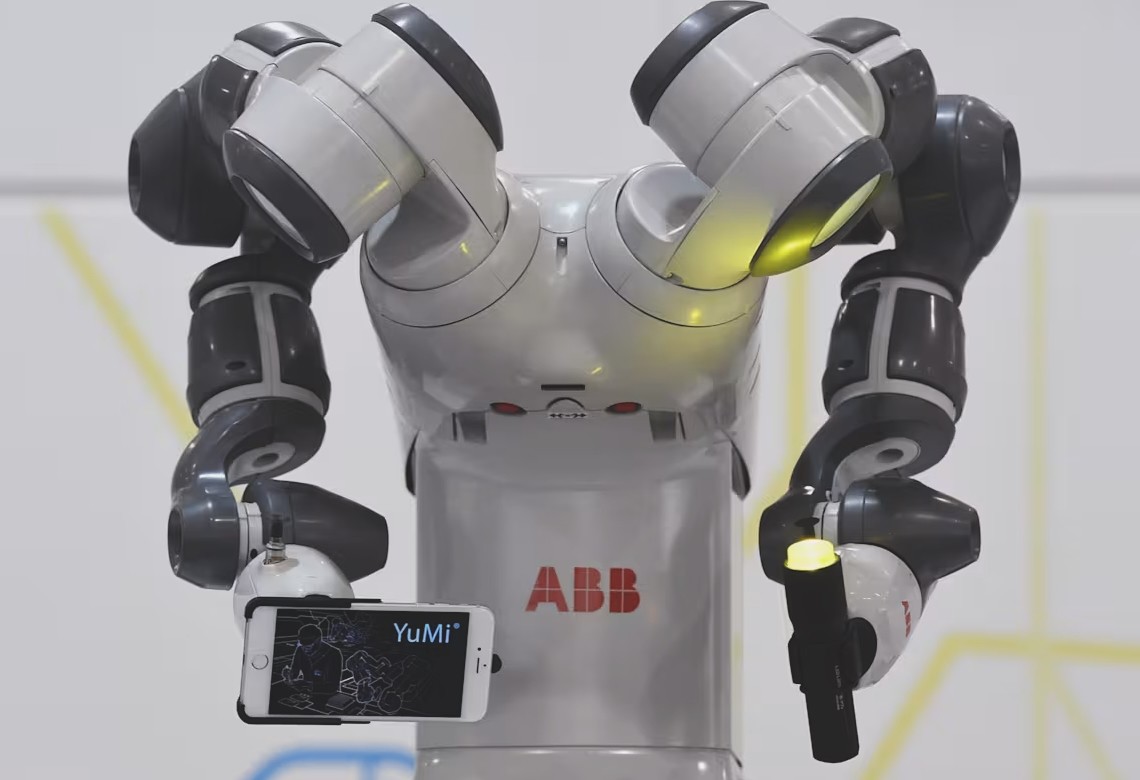
Training robots before deployment: Nvidia and ABB are partnering to connect Nvidia’s Omniverse simulation platform with ABB’s industrial robotics software, enabling robots to be trained inside digital twins before being deployed in real factories.
From programming to learning: Manufacturers can use simulated environments to teach robots how to perform tasks, test thousands of scenarios, and transfer those capabilities directly into physical systems.
The new robotics development cycle: Training robots in simulation shifts automation toward the model of modern AI, where systems improve iteratively through data rather than remaining fixed after deployment.
Source: “Nvidia and ABB launch partnership for AI-enabled autonomous robots”
DeepMind’s RoboBallet and the Next Wave of Coordination
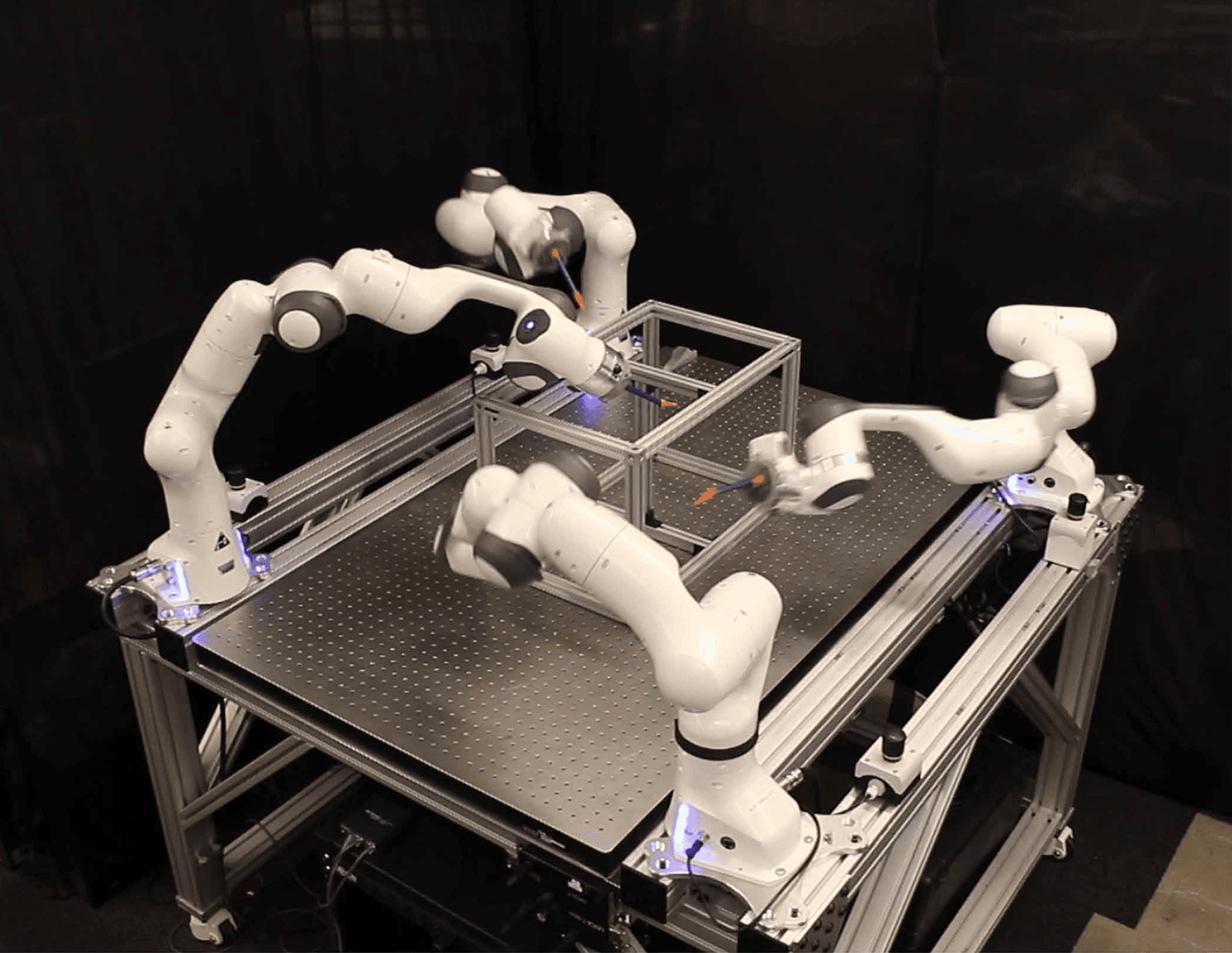
Inside the cell: While Foundational has focused on AI-native robotics for extensible manufacturing beyond the core work cell, RoboBallet, a research project from our friends at DeepMind, offers a glimpse of what’s coming next—multi-agent robotic arms coordinating within the cell itself.
From static code to adaptive motion: The shift from pre-programmed paths to collaborative, learned behavior points to a future where robotic choreography is emergent, not engineered.
Expanding the circle: While our near-term focus remains on generalizable manufacturing systems, advances like this hint at a deeper transformation—one where even traditionally SKU-specific hardware becomes fluid, adaptive, and part of an extensible whole.
Source: “RoboBallet: Planning for multirobot reaching with graph neural networks and reinforcement learning”
China’s Robotics Surge and the U.S. Industrial Gap
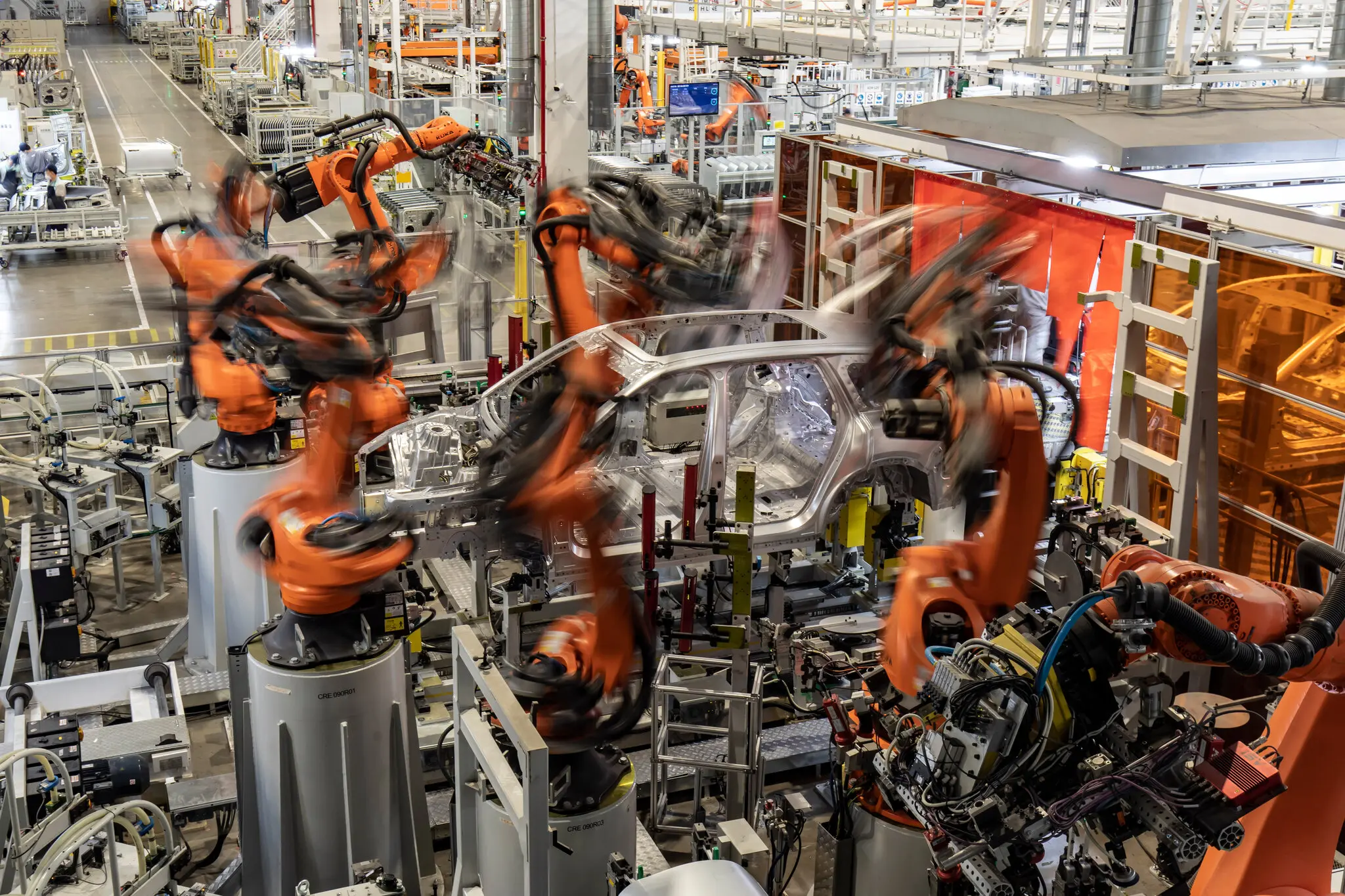
Industrial gap, made visible: Another reminder of the widening U.S. deficit in industrial automation relative to China. Not news to those in the field—but the fact that it’s entering the mainstream conversation amid trade tension and geopolitical rivalry is.
Ecosystems, not factories: China’s advantage isn’t just cheap labor or state policy; it’s the interconnected ecosystem that links hardware, supply chains, and capital formation into a continuous automation flywheel.
Leapfrog, don’t copy: The opportunity for the U.S. isn’t to replicate last-generation static systems, but to vault ahead—to build AI-native, adaptive robotics that render legacy automation architectures obsolete.
Source: "There Are More Robots Working in China Than the Rest of the World Combined"

A16Z’s Ben & Marc on the AI robotics and the Future of US Manufacturing
An oldie but a goodie: Ben and Marc—founders of a16z, with one of the most forward-looking AI-robotics portfolios—offer one of the clearest conversations yet on the coming convergence of AI and robotics
From perception to physics: Around the one-hour mark, Ben delivers a sharp primer on Robot Foundation Models—how robots might learn the laws of physics directly from real-world video data rather than abstract simulation.
A blueprint for reindustrialization: At 1:12, Marc argues that America’s manufacturing revival depends on fully AI-native factories. We share his call for an Operation Warp Speed for Manufacturing—a national effort that, while uniquely suited to U.S. strengths in AI, will demand a new generation of trade schools training the “manufacturing technologists” who will make it real.
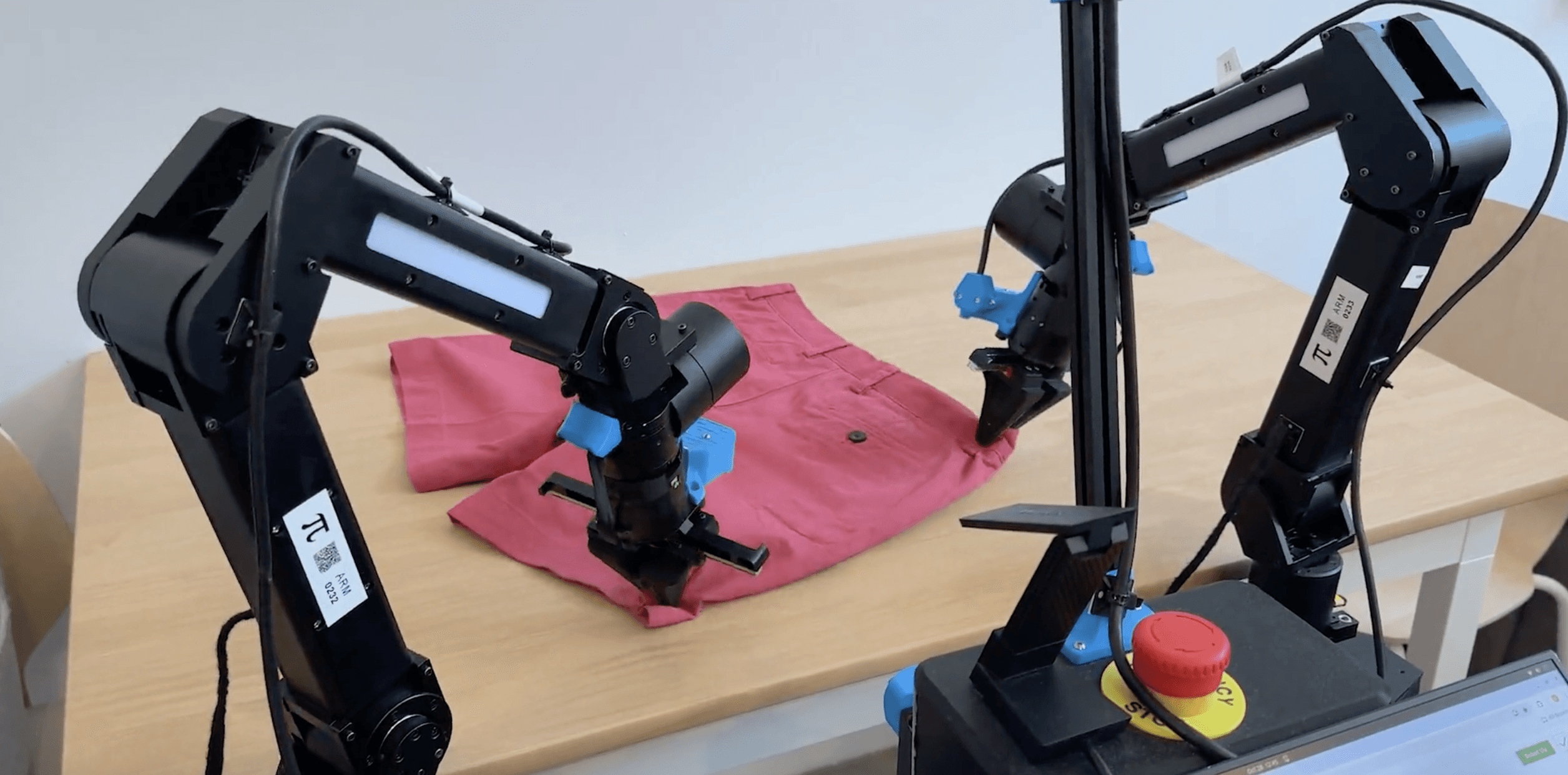
Physical Intelligence and the ChatGPT Moment for Robotics
A watershed moment: Physical Intelligence’s emergence from stealth marked the closest thing yet to a ChatGPT moment for robotics—a public proof that generalized robotic intelligence is moving from research to reality.
From domestic to industrial: While the company and the broader RFM ecosystem have since evolved, this announcement still stands as a north star for what’s next: robotic understanding of physics which will ultimately transcend these illustrative domestic tasks and begin to operate in complex industrial environments.
Direction of travel: The trajectory is clear—foundation models will become the substrate for physical intelligence, turning robots from task executors into adaptive agents capable of learning, collaborating, and reasoning about the physical world.
Foundational and the Factory as a System
Beyond point automation: The next industrial leap isn’t another robot arm or vision system bolted onto a legacy production line. Foundational is building factories from the ground up to be run by software, treating the entire production system as the unit of automation.
The factory starts in software: Before building the physical system, Foundational has built the factory in software using emulators. This software-first architecture creates a foundation for deploying, testing, and ultimately improving manufacturing capabilities before they reach the factory floor.
A compounding factory model: The larger wager is that AI-native factories can improve with each deployment, becoming cheaper and faster to build over time. Instead of automation economics that depend on rigid equipment and constant utilization, Foundational is pursuing a model where software and intelligence compound across factories.
Source: “Forget robots on assembly lines. Foundational Industries wants AI to run the entire factory”
The Factory Is the Product
Capacity is capability: Military advantage depends on more than fielding sophisticated weapons. It requires the ability to replenish, adapt, and manufacture at scale, making the means of production a strategic asset in their own right.
From products to production capacity: The authors propose a Capacity-as-a-Service model that would reward manufacturers for maintaining flexible production capability over time, rather than paying only for one-time runs of hardware. The result is an industrial base designed to grow, adapt, and surge as requirements change.
Factories that compound: Treating capacity as the product changes the economics of manufacturing itself. Instead of optimizing factories around short production runs, manufacturers can invest in scalable processes, advanced tooling, and automation that continuously lower costs, increase throughput, and make production more adaptable over time.
Source: “The Factory Is the Product”
Prompt-to-Print and the Future of Manufacturing
Natural language becomes the interface: As generative AI matures, manufacturing begins to shift from traditional CAD workflows toward prompt-driven design, where engineers describe intent in natural language and AI translates it into manufacturable geometry.
From design tools to manufacturing agents: Rather than simply accelerating existing workflows, AI has the potential to become an active participant in product development, iterating on designs, incorporating manufacturing constraints, and compressing the path from concept to production.
Manufacturing at the speed of thought: The long-term implication extends beyond faster prototyping. As AI-native design tools converge with digital manufacturing, the path from intent to production becomes dramatically shorter, enabling products to move from prompt to physical reality with unprecedented speed and flexibility.
Rethinking the Geography of Manufacturing
The factory map is changing: McKinsey argues that global manufacturing footprints are being reshaped by geopolitical risk, supply-chain fragility, and the accelerating pace of technological change.
Resilience over optimization: The era of purely cost-optimized global production is giving way to distributed manufacturing strategies that prioritize resilience, regionalization, and technological capability.
Technology as the new anchor: As robotics and advanced automation mature, production location will increasingly be determined by infrastructure, talent, and technology ecosystems rather than just labor cost.
Source: “Decoding disruption to reshape manufacturing footprints”
Physical AI and the Next Frontier of Robotics
AI leaves the screen: Deloitte’s Tech Trends 2026 report highlights the emergence of “physical AI”, which describes systems that move beyond digital outputs to perceive, reason, and act within the physical world through robots and embodied machines.
From automation to autonomy: Advances in sensors, foundation models, and edge compute are enabling robots to adapt to dynamic environments rather than executing rigid, pre-programmed tasks.
Manufacturing as the proving ground: Factories and logistics networks are likely to be the first large-scale environments where physical AI is deployed, turning robots from single-purpose tools into learning systems that continuously improve through interaction with the real world.
Source: “AI goes physical: Navigating the convergence of AI and robotics”
Simulation as the Training Ground for Robots
Training robots before deployment: Nvidia and ABB are partnering to connect Nvidia’s Omniverse simulation platform with ABB’s industrial robotics software, enabling robots to be trained inside digital twins before being deployed in real factories.
From programming to learning: Manufacturers can use simulated environments to teach robots how to perform tasks, test thousands of scenarios, and transfer those capabilities directly into physical systems.
The new robotics development cycle: Training robots in simulation shifts automation toward the model of modern AI, where systems improve iteratively through data rather than remaining fixed after deployment.
Source: “Nvidia and ABB launch partnership for AI-enabled autonomous robots”
DeepMind’s RoboBallet and the Next Wave of Coordination
Inside the cell: While Foundational has focused on AI-native robotics for extensible manufacturing beyond the core work cell, RoboBallet, a research project from our friends at DeepMind, offers a glimpse of what’s coming next—multi-agent robotic arms coordinating within the cell itself.
From static code to adaptive motion: The shift from pre-programmed paths to collaborative, learned behavior points to a future where robotic choreography is emergent, not engineered.
Expanding the circle: While our near-term focus remains on generalizable manufacturing systems, advances like this hint at a deeper transformation—one where even traditionally SKU-specific hardware becomes fluid, adaptive, and part of an extensible whole.
Source: “RoboBallet: Planning for multirobot reaching with graph neural networks and reinforcement learning”
China’s Robotics Surge and the U.S. Industrial Gap
Industrial gap, made visible: Another reminder of the widening U.S. deficit in industrial automation relative to China. Not news to those in the field—but the fact that it’s entering the mainstream conversation amid trade tension and geopolitical rivalry is.
Ecosystems, not factories: China’s advantage isn’t just cheap labor or state policy; it’s the interconnected ecosystem that links hardware, supply chains, and capital formation into a continuous automation flywheel.
Leapfrog, don’t copy: The opportunity for the U.S. isn’t to replicate last-generation static systems, but to vault ahead—to build AI-native, adaptive robotics that render legacy automation architectures obsolete.
Source: "There Are More Robots Working in China Than the Rest of the World Combined"
A16Z’s Ben & Marc on the AI robotics and the Future of US Manufacturing
An oldie but a goodie: Ben and Marc—founders of a16z, with one of the most forward-looking AI-robotics portfolios—offer one of the clearest conversations yet on the coming convergence of AI and robotics
From perception to physics: Around the one-hour mark, Ben delivers a sharp primer on Robot Foundation Models—how robots might learn the laws of physics directly from real-world video data rather than abstract simulation.
A blueprint for reindustrialization: At 1:12, Marc argues that America’s manufacturing revival depends on fully AI-native factories. We share his call for an Operation Warp Speed for Manufacturing—a national effort that, while uniquely suited to U.S. strengths in AI, will demand a new generation of trade schools training the “manufacturing technologists” who will make it real.
Physical Intelligence and the ChatGPT Moment for Robotics
A watershed moment: Physical Intelligence’s emergence from stealth marked the closest thing yet to a ChatGPT moment for robotics—a public proof that generalized robotic intelligence is moving from research to reality.
From domestic to industrial: While the company and the broader RFM ecosystem have since evolved, this announcement still stands as a north star for what’s next: robotic understanding of physics which will ultimately transcend these illustrative domestic tasks and begin to operate in complex industrial environments.
Direction of travel: The trajectory is clear—foundation models will become the substrate for physical intelligence, turning robots from task executors into adaptive agents capable of learning, collaborating, and reasoning about the physical world.
" height="41.973144px" id="H18NoxJX8" transform="translate(0.727 0.723)" width="48.000037999999996px"/></svg>)
Interested in learning more?
Interested in learning more?